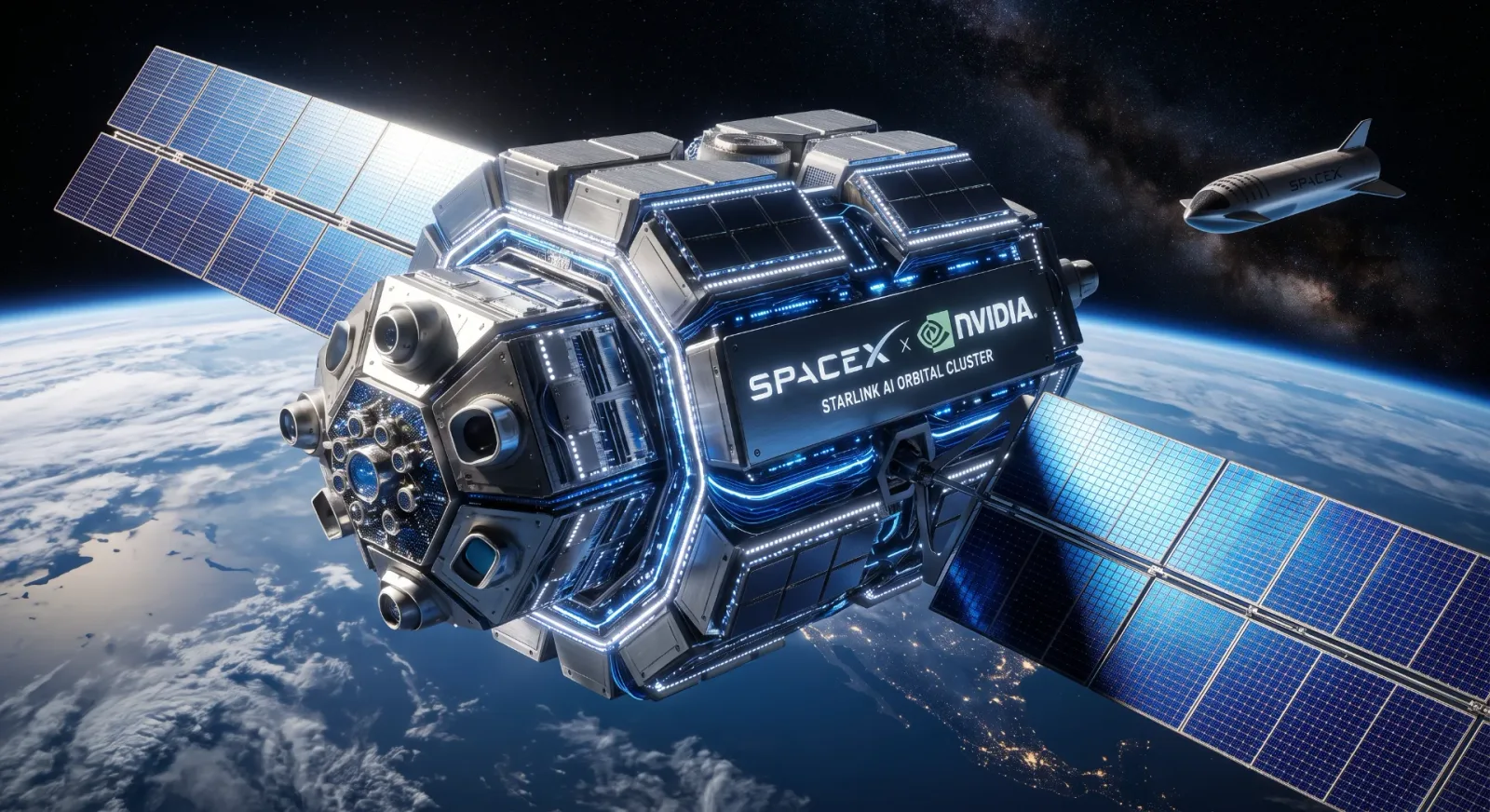
SpaceX and NVIDIA have formalized a strategic alliance to move artificial intelligence infrastructure beyond Earth's limits. Through the project dubbed Starmind and its first test satellites, AI1, both companies plan to deploy orbital data centers equipped with NVIDIA's next-generation architecture.
Why Take AI Computing to Space?
The exponential growth of frontier models has collided with three critical bottlenecks on Earth:
- Energy supply: Gigawatt-scale data centers saturate terrestrial power grids. In a sun-synchronous orbit, satellites receive continuous solar radiation more than 98% of the time, generating clean, uninterrupted power through massive photovoltaic panels (estimated at over 200 kW per unit).
- Thermal dissipation: Instead of requiring millions of liters of water or evaporative cooling towers, heat is transferred to large-surface liquid radiators that expel thermal energy directly into the vacuum of space via infrared radiation.
- Space and sovereignty: It avoids land-use restrictions, environmental permits, and local physical infrastructure, interconnecting globally through optical laser links compatible with the Starlink constellation.
The Architecture: NVIDIA Vera Rubin in Orbit
The computing platform selected for the project is based on an aerospace-optimized version of the rack-scale NVIDIA Vera Rubin NVL72 system (the Space-1 module):
Technical Challenges and Mitigation
Operating bleeding-edge silicon in the harsh space environment presents unique obstacles, but the engineering roadmap already includes concrete countermeasures:
- Cosmic radiation and single-event upsets: High-energy particles can corrupt memory or trigger computation errors. The Space-1 modules combine radiation-hardened controllers, triple modular redundancy (TMR), and automatic checkpoint-restart orchestration so that a transient fault is corrected in milliseconds without impacting workloads.
- Vacuum thermal management: Without air convection, eliminating heat relies solely on radiative surfaces. The satellites use deployable liquid-loop radiators with phase-change heat sinks that absorb thermal peaks, keeping the Vera Rubin dies within their operating envelope during intense inference bursts.
- Autonomous maintenance and scalability: Orbital repair is not practical yet. The system uses a serviceable modular bay design: failed units are logically isolated, tasks are migrated to healthy nodes, and the satellite swarm's distributed scheduler rebalances AI jobs across the constellation, ensuring graceful degradation rather than total failure.
- Launch cadence and cost: Each AI1 satellite is designed to be compact enough for ride-share launches on Falcon 9, while Starship's future payload capacity will enable deploying several Space-1 racks per mission, dramatically reducing the cost per petaflop in orbit.
With this first orbital test campaign, SpaceX and NVIDIA aim to validate the viability of a new class of persistent, energy-autonomous AI infrastructure—one that operates beyond the limits of terrestrial sovereignty and physical constraints.