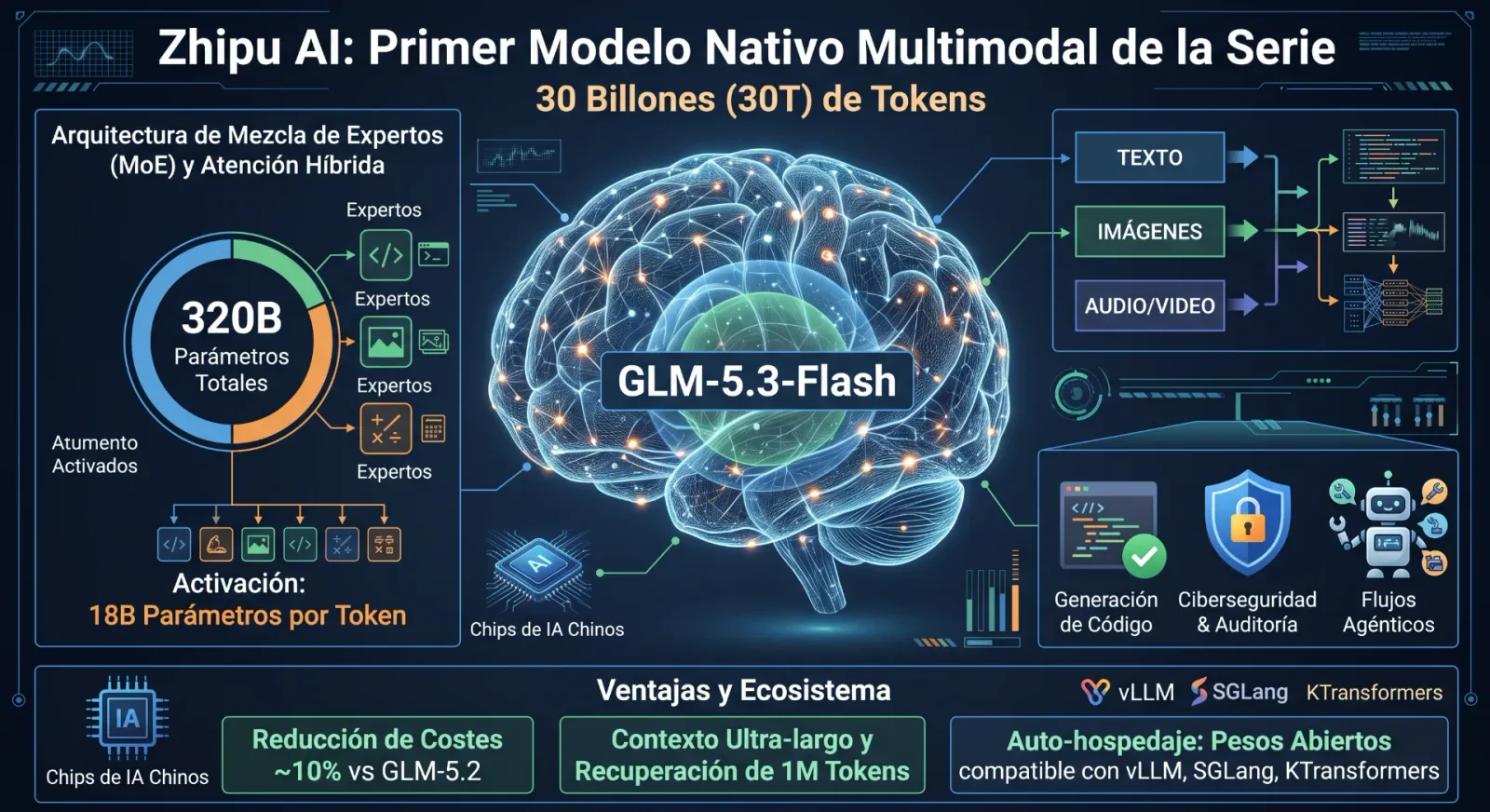
The global artificial intelligence ecosystem is experiencing another inflection point with the open release of GLM-5.3-Flash by Chinese lab Zhipu AI (Z.ai). This launch marks a technical milestone within the General Language Model series, becoming its first natively multimodal model, designed from the pre-training stage to understand text, images, and complex signals in a unified manner across a massive data scale.
Trained on a colossal corpus of 30 trillion (30T) tokens, GLM-5.3-Flash not only competes in data volume with top Western labs but also redefines the balance between raw power, energy consumption, and operational viability for local and industrial deployments.
Extreme Efficiency: 320B Parameters with 18B Activation
The true achievement of GLM-5.3-Flash lies in its Mixture of Experts (MoE) architecture and its innovative attention mechanism:
- Sparse activation: The model has a total of 320 billion parameters (320B), but thanks to dynamic routing, it activates only 18 billion (18B) per processed token.
- Hybrid Attention (Sparse & Linear Attention): Combines sparse attention layers with linear attention cores, drastically reducing the quadratic computational complexity ($O(N^2)$) typical of transformers when processing long context windows.
- Radical cost reduction: In complex problem-solving tasks and agentic code execution, GLM-5.3-Flash reduces cost per task to an estimated $0.045 USD, representing roughly 10% of the operational cost of its predecessor, GLM-5.2.
The “Ox-Alpha” Revelation and the Boost of National Hardware
Weeks before its official announcement, the open-source community and inference platforms such as OpenRouter and OpenCode began experimenting with an anonymous model under the codename Ox-Alpha. Its scores on long-horizon code generation and multimodal reasoning immediately surpassed leading industry variants, triggering speculation until Zhipu AI confirmed its identity.
A strategically fundamental aspect of this development is its infrastructure: GLM-5.3-Flash was trained and optimized to run efficiently on domestic Chinese accelerators, including Ascend clusters, reducing dependence on advanced Western GPUs. This aligns with Beijing's push for technological self-sufficiency and represents a major step toward sovereign AI infrastructure.
Open Weights: A Strategic Bet for Global Adoption
Unlike many closed commercial models, Zhipu AI has chosen to release GLM-5.3-Flash with open weights under permissive licensing, enabling researchers and startups to fine-tune and deploy the model on private infrastructure. According to the lab, the combination of multimodal understanding and reduced operational costs makes the Flash variant especially attractive for edge inference, real-time document processing, and on-premise RAG pipelines.
Despite geopolitical restrictions on advanced silicon exports, the Chinese ecosystem is demonstrating that algorithmic efficiency and hardware-software co-design can close the gap. With GLM-5.3-Flash, Zhipu AI not only challenges the paradigm of always-larger models, but also validates a future where cost per token and energy efficiency become the main competitive battlegrounds.
Benchmark Highlights and Practical Implications
Early community benchmarks show GLM-5.3-Flash outperforming much larger closed alternatives in multimodal reasoning, particularly in chart interpretation, visual coding assistance, and localized Chinese-English document understanding. For businesses, this translates into lower API spend, faster response times, and full data sovereignty when self-hosting on managed VPS infrastructure.
As the frontier of open models shifts, GLM-5.3-Flash is poised to become the default choice for teams seeking best-in-class multimodal intelligence on a budget.