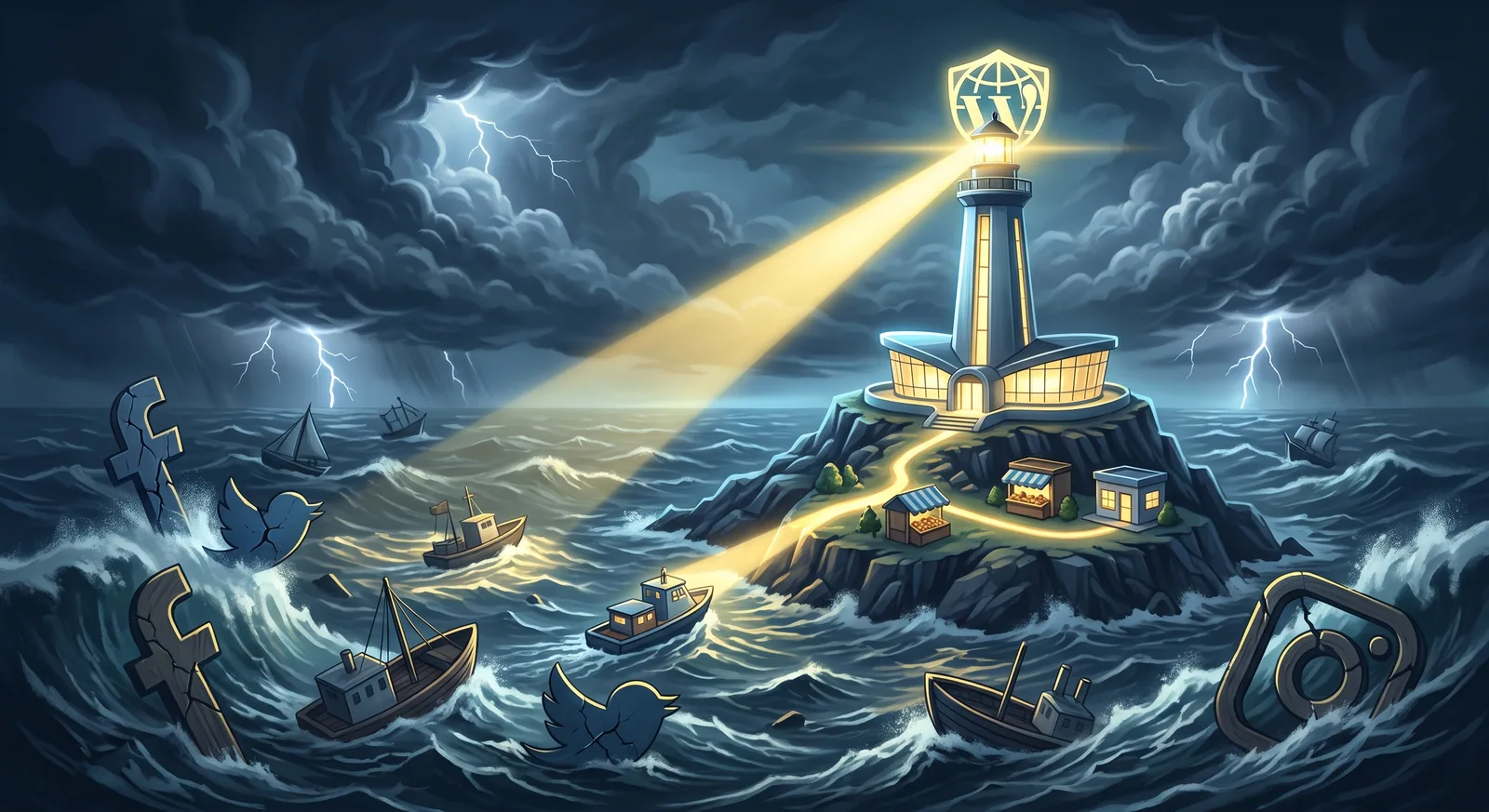
1. The Digital Imperative: Beyond Presence, Survival
In 2025, digitalization is not a veneer of modernity; it is a survival infrastructure. Let's be direct: if you rely exclusively on an Instagram or Facebook algorithm to feed your family, you don't have a business; you have a high-risk hobby. Currently, 99% of consumers use the internet to find local businesses, and 81% research a company before making any contact.
Despite these figures, 1 in 5 small businesses still makes the fatal mistake of relying solely on social media. This complacency creates a "legitimacy gap" that competitors do not hesitate to exploit. In today's landscape, the website is the filter that separates professionals from those just "testing the waters." Bill Gates' premise remains relevant, but with a pragmatic consulting nuance: your website is not a brochure; it is your primary market tool.
2. The Social Media Fallacy: Building on "Rented Land"
From a strategic standpoint, operating only on social media is like being a tenant at the mercy of an unpredictable landlord. You do not own your audience or your channel. The collapse of organic reach, now reduced to a meager 2%-5%, has turned these platforms into a mandatory pay-to-play model. You are paying to talk to the people you already worked hard to attract.
The limitations of a "Social-Only" presence are critical for any growth strategist:
- Vulnerability to the "Reddit Effect": Pieter Levels learned that when traffic spikes, infrastructure fails. A website of your own allows you to "scale down" (for example, converting dynamic pages to static HTML to survive a traffic surge), while a Meta outage or account suspension leaves you 100% commercially dead.
- Search Engine Invisibility: 70% of web traffic begins on search engines. Social networks are closed ecosystems that do not rank for general searches (e.g., "comprehensive renovations in Madrid").
- Generic Design: On social media, your brand is a template. On your own domain (yourbusiness.com), you have total sovereignty over the user experience.
3. The Website as an Anchor of Credibility and Control
Your website is the cornerstone of your digital reputation. It is where potential customers verify your legitimacy, assess your professionalism, and decide whether to trust you. Without it, you are invisible in the eyes of quality-conscious consumers. Moreover, a website gives you control over your narrative, your data, and your customer relationships—assets that social platforms can take away at any moment.
4. The Path Forward: Invest in Your Digital Sovereignty
In an era of social uncertainty, the smartest investment you can make is in an asset you fully own. A well-designed, optimized website is not an expense; it is a revenue-generating tool that works for you 24/7. At WorksLab, we specialize in building websites that not only look great but are engineered for performance, SEO, and resilience. Don't leave your business's future in the hands of a rented algorithm. Take control today.