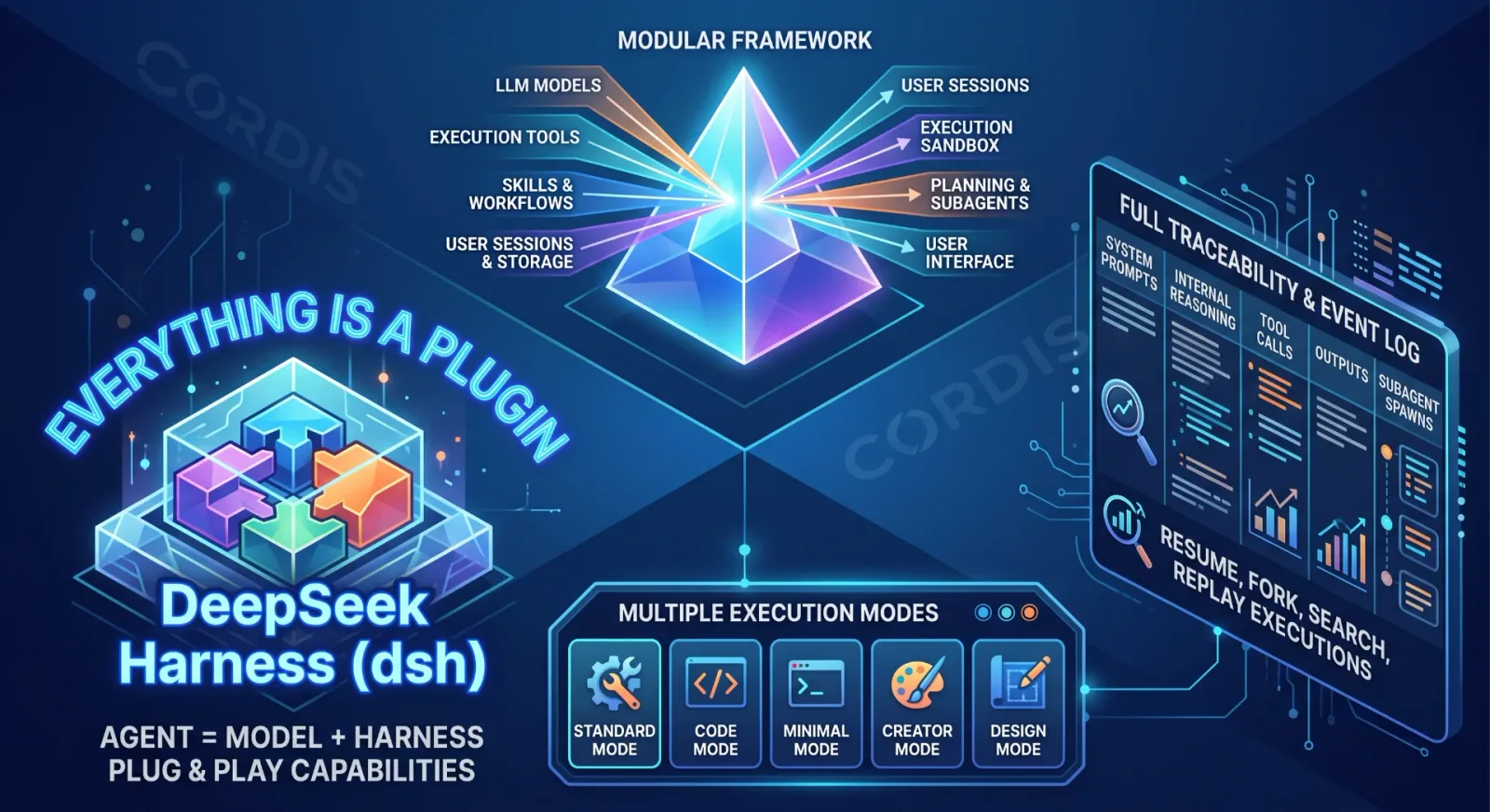
The development of autonomous agents has undergone a paradigm shift with the arrival of DeepSeek Harness (dsh), the open-source execution environment from DeepSeek AI. Its core philosophy, "Everything is a plugin", introduces a highly modular, flexible, and auditable structure designed to seamlessly connect language models with real-world applications.
The key idea: what defines an agent?
For DeepSeek, the equation is simple and powerful:
Agent = Model + Harness
The model provides the cognitive capacity — the agent's "brain" — while the harness constitutes the essential infrastructure that allows it to interpret its environment, use tools safely, manage complex states, and operate continuously in production systems.
This architecture is built on Cordis, an internal engine that adopts a spatiotemporal composability approach, facilitating clean, decoupled interaction between services and events.
How does dsh work in practice?
Unlike traditional frameworks where the execution flow is rigidly defined, dsh organizes the agent lifecycle around discrete events. Each model action, each tool call, and each state transition becomes an event processed by the Cordis engine. This allows developers to compose complex behaviors by combining small reusable modules without rewriting core logic.
Furthermore, the plugin system is managed through configuration files (e.g., YAML or JSON). A plugin can expose tools, lifecycle hooks, or high-level skills. A simple configuration change is enough to activate a new language model, connect a vector store, or enable a sandbox environment for untrusted code execution.
Comparison with other agent frameworks
While frameworks like LangChain or AutoGen offer powerful abstractions but often couple components to their own APIs, dsh positions itself as a more granular orchestration layer. The complete separation between the core and extensions allows developers to adopt the harness without being locked into a specific ecosystem. This design philosophy makes dsh particularly attractive for teams that want to maintain control over their infrastructure while leveraging the power of AI agents.
Full traceability and auditability
One of the most distinctive aspects of dsh is its commitment to transparency. Since every event is recorded and processed through the Cordis engine, each decision made by the agent can be traced, inspected, and reproduced. This level of observability is crucial for production environments where trust, compliance, and debugging are non-negotiable. Teams can audit why an agent took a certain action, which tools it invoked, and how the context evolved over time.
Real-world use cases
DeepSeek Harness is already being used to build a wide range of autonomous systems: from intelligent customer support bots that manage tickets and escalate issues, to data analysis assistants that query databases and generate reports, to DevOps agents that monitor infrastructure and respond to incidents. Its modular nature makes it an ideal foundation for organizations looking to implement AI agents without committing to a monolithic framework.
Conclusion
DeepSeek Harness represents a significant step forward in the development of autonomous agents. By adopting a plugin-driven architecture, a decoupled event engine, and full traceability, dsh offers developers a flexible, transparent, and production-ready alternative. Whether you are exploring AI agents for the first time or looking to scale an existing deployment, DeepSeek Harness provides the tools to build with confidence and clarity.